
If you are moving to the US or Canada to study, work, or settle, there is a good chance someone has already told you to get your degree evaluated by WES. What nobody explains is that the evaluation is the easy part. The translations are where applications stall.
This guide covers what World Education Services actually asks for, which documents you need, what makes a translation acceptable, how long the whole thing takes, and what it costs. Read it before you order anything. A few minutes here saves the weeks you would lose to a rejected file.
What Is World Education Services?
Start here if WES is new to you, because the rest of this makes more sense once you know what the report is for.
World Education Services is a nonprofit organization and one of the most widely recognized credential evaluation agencies in North America. Universities use their reports for admissions decisions, employers use them for hiring, and immigration officers use them as proof of foreign education. If you earned your qualification outside North America, WES is often the bridge between what you have and what an institution here can read.
What a WES Credential Evaluation Actually Is?
A WES credential evaluation is a report that compares your foreign qualification against its US or Canadian equivalent. It takes a three year bachelor’s from one country and tells an admissions officer exactly how that measures up locally.
There are two main report types. A document by document report confirms what you studied and what level it sits at. A course by course report goes further and lists every subject with credit hours and a converted GPA. Graduate programmes and licensing boards almost always want the second one.
Who Actually Needs One?
Applicants to graduate school. Nurses, engineers, teachers, and accountants chasing a professional licence. Anyone in a Canadian immigration stream that awards points for education. And plenty of people who simply want a hiring manager to stop squinting at an unfamiliar university name.
In all of those cases the report is only as good as the paperwork behind it, which is why so many applicants pair their submission with WES translation services before they even open an account.
Why WES Asks for Translations?
The logic is simple, but the rule that follows from it trips people up constantly.
WES evaluators cannot assess a transcript they cannot read. So if your documents were issued in a language other than English, you have to supply English translations. That is the whole reason the requirement exists.
Translations Sit Alongside the Originals, Never Instead of Them
This is the part people get wrong most often. Your translation does not replace your original language transcript. Both go in. WES verifies the original with your institution and reads the translation to do the evaluation. Send only one and your file sits in limbo until the other arrives.
What Happens When a Translation Falls Short
Nothing dramatic. You just get an email asking for a corrected version, and the clock resets. That is the frustrating part, because a summarised course title or a missing grading key can cost you three weeks for something a translator would have caught in three minutes. A properly prepared certified translation removes that risk entirely.
Common Documents WES Asks For
What to gather before you order, so you are not paying for a second round later.
Requirements shift depending on which country issued your credential and which report you ordered. That said, the same handful of documents comes up again and again.
The Core Academic Set
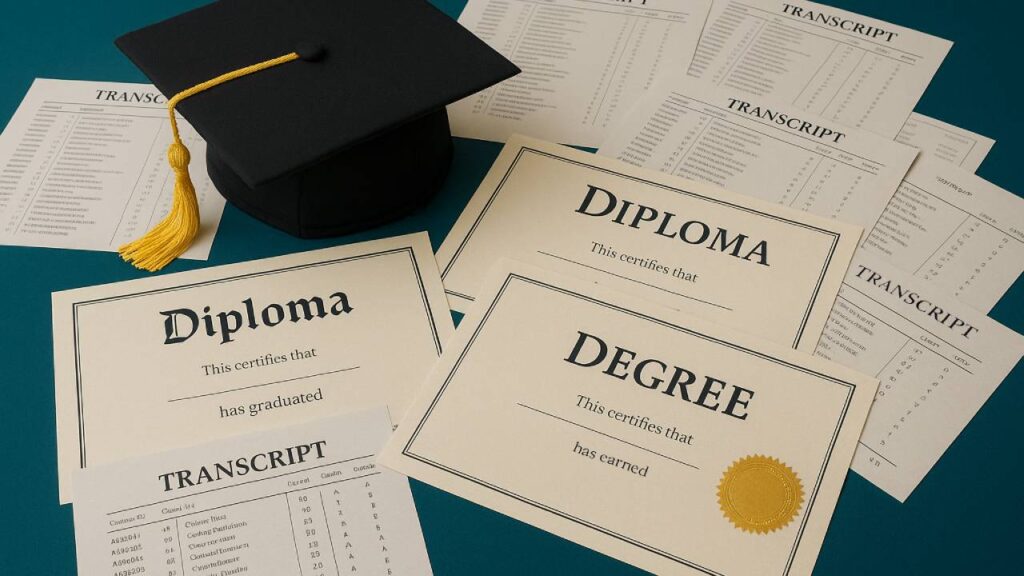
- Academic transcripts or mark sheets for every year of study
- Degree certificates
- Diplomas
- Provisional certificates, where the final one has not been issued
- Grading scales or marking keys printed by the institution
A degree certificate and a transcript are two separate documents, and both usually need translating. Applicants who order only the transcript are often surprised to learn they also need a diploma translation to complete the set. Ordering both together keeps names, dates, and spellings consistent across the file.
Country Specific Extras
Some education systems add their own paperwork. Consolidated mark sheets, migration certificates, degree verification letters, and statements of marks all show up on WES required document lists depending on where you studied. WES publishes these lists by country on their own site, and checking yours before ordering anything is the cheapest insurance available. Many applicants bundle everything into one WES transcript translation order so nothing arrives out of sequence.
Does WES Translate Documents Directly?
One of the most searched questions about the process, with a short answer.
No. World Education Services does not offer translation. They are an evaluation body, not a language service, and they say so plainly in their own guidance. Getting your documents translated is entirely on you, and it has to happen before you submit.
Why This Is Actually Good News
It sounds like an extra hurdle. In practice it works in your favour. You pick the provider, you control the turnaround, and you review the work before anything reaches WES. If translation were bundled into the evaluation, you would be stuck in someone else’s queue with no visibility.
When to Book the Translation
As soon as you have clear scans and a WES reference number. Do not wait for your institution to mail the sealed originals, because those two tracks run in parallel. Ordering a WES certified translation early means your translated set is sitting ready the moment your account is live, and you can start your order with nothing more than a good quality scan.
WES Translation Requirements You Must Know
The specific rules a translation has to satisfy. Miss one and the file comes back.
WES is precise about what it accepts, and the standards are stricter than most people expect. Asking a bilingual colleague to help seems efficient. It almost never survives the first review.
The Rules in Plain English
- Complete, with nothing omitted, added, or summarised
- Word for word, with no interpreting or explaining of terminology
- Laid out in the same format as the original document
- Typed, never handwritten
- Uploaded as a clear PDF or JPEG under 10 MB
- Produced by a professional translator or a university translation office
Translations done by the applicant, by relatives, or by friends are rejected regardless of how fluent those people are. It is not about language ability. It is about independence. WES accepts source documents in a very wide range of languages, so whichever of the languages we cover applies to your file, the same standard holds throughout.
What Exactly Is a Certified Translation?
The word certified sounds like it implies a government licence. In the WES context it does not. It refers to something the translator attaches to the work.
A certified translation comes with a signed statement, usually called a Certificate of Accuracy or a Translator’s Declaration. That statement confirms the translation is complete and accurate to the best of the translator’s ability, and confirms the translator is competent in both languages. The certificate is what turns an accurate translation into an acceptable one. Common certification questions are answered in more detail in our FAQ.
How to Get Your Documents Certified
Use a provider that already works with credential evaluation bodies. Established agencies build the certification wording into every delivery rather than treating it as an optional extra, and they know what WES formatting looks like.
When you place the order, say up front that the documents are going to WES or WES Canada. That one sentence changes how the translator handles grading scales, institutional seals, and untranslatable titles. The same principle applies if you are also preparing immigration translation files, since both sets often get reviewed in the same window.
Special Rules for WES Canada
If your evaluation is running through Canada for immigration or study, read this twice. WES Canada supports the immigration assessment report process and its rules differ slightly from the US ones.
WES Canada frequently states that translations must come from a certified translator. In practice that means official recognition from a provincial or territorial translation association, such as a CTTIC affiliate, or comparable verifiable credentials. Documents must be submitted in either English or French. If your file is headed to Quebec or a francophone institution, a French translation is often the smoother route.
Translating International Transcripts for WES Step by Step
The order of operations, so nothing gets done twice or too late.
The requirements can feel like a lot when you read them all at once. Taken one at a time, it is a straightforward sequence.
Before You Order Anything
Open your WES account first and pay the evaluation fee. That generates your reference number, which some institutions ask for and which keeps every document tied to your file. Then pull your required document list for your country of education. Only after that should you count pages and request quotes.
The Six Steps
- Confirm exactly which documents need translating
- Choose a qualified translation provider
- Send clear, complete, high quality scans of the original language documents
- Review the finished translation against the original, line by line
- Check the Certificate of Accuracy is included, signed, and dated
- Submit the translations according to WES upload instructions
Reviewing your own translation feels unnecessary. Do it anyway. You are the only person who knows how your name is spelled on every other document in the application. If your degree certificate is going in alongside the transcript, a matching WES diploma translation keeps both consistent, and you can confirm the page count in your cart before checkout.
What Your School Still Has to Send
Your translated documents do not release your institution from its part. In most countries the original language transcript still has to travel directly from the school to WES, often in a sealed envelope, as part of the verification step. Translations are additional, not a substitute.
What About WES Translation Costs?
Where the money actually goes, and how to avoid paying more than you need to.
Translation is a separate expense from the WES evaluation fee, and applicants routinely forget to budget for it.
What Moves the Price?
Four things, mostly. The language pair, since Spanish to English costs less than a rare regional language. The number of pages. The density of the document, because a four year transcript with sixty subject lines is not the same job as a one page diploma. And turnaround, since express delivery carries a premium almost everywhere.
What You Should Expect to Pay?
Most reputable providers charge per page for academic documents, typically somewhere between $25 and $75 per page depending on the factors above. Anything dramatically below that range is usually machine output with a certificate stapled on, which WES will reject. Current page rates are listed in the shop if you want to compare before committing.
LinguaOne translates documents for WES submission in multiple languages at $44.99 per page, with express delivery available. Document sets vary, so if yours is unusual or urgent, request a free quote and you will get a fixed total before any work starts.
Frequently Asked Questions
The questions applicants ask most often, answered briefly.
How Long Does a WES Evaluation Take?
Roughly seven business days once WES has received and verified everything, though verification with your institution can add weeks on top. Translations should be finished before you submit so they are never the bottleneck. Our team can contact us with a realistic turnaround for your document set.
How Much Is a WES Evaluation?
It depends on the report type, with course by course costing more than document by document, plus delivery fees if you want copies sent to institutions. That is entirely separate from translation, which is billed per page by your professional translation provider.
What Is a WES Reference Number?
The unique identifier WES assigns once you create an account and pay. It goes on documents and correspondence so everything is matched to your file. Get it before you order translations, and give it to your provider so it appears where needed on the transcript translation delivery.
Can I Translate My Own Documents for WES?
No, and this holds even if you are a qualified translator. Applicants, relatives, and friends are all excluded. You can read more about how our translators are assigned and reviewed on our about us overview.
Does WES Accept Notarized Translations?
WES asks for certified translations, not notarized ones. Notarization verifies who signed a document. Certification attests that the translation itself is accurate. Certification is the part that matters, and the same distinction applies when preparing immigration documents for USCIS.
Do I Need to Translate Documents Already Issued in English?
No. If your institution issued it in English, leave it as is. Mixed language documents are the exception, since any section in another language still has to be translated in full. Our Spanish translation team handles a steady stream of these partial cases.
Can Handwritten Academic Records Be Translated?
Yes, as long as the handwriting is legible in your scan. The finished translation must be typed. Older records in regional scripts are common, and our Chinese translation team works with them regularly.
Do You Offer In Person Support for Applicants?
Yes. Alongside document work we schedule live language support for interviews, appointments, and consultations across Minnesota and nationwide. Details are listed under interpreting services.
Final Thoughts
What to take away before you start ordering.
WES translation requirements look intimidating written down. In practice they come down to three habits. Use an independent professional translator. Make sure a signed Certificate of Accuracy is attached. Check your country’s required document list before you pay for anything.
Do those three things and the translation stage stops being the reason your evaluation is delayed. It becomes the part you stopped worrying about weeks ago.

