
Someone at a government office hands your paperwork back and tells you the translation needs to be notarized. You nod, walk out, and then realise you are not sure what that actually means or whether the translation you already paid for counts.
It is one of the most common points of confusion we deal with. Certified and notarized sound like they belong together, and plenty of websites treat them as the same thing. They are not, and paying for the wrong one costs you both the money and the week it takes to sort out.
Here is what a notarized translation is, when you genuinely need one, and when you are being asked for something you do not.
What Is A Notarized Translation?
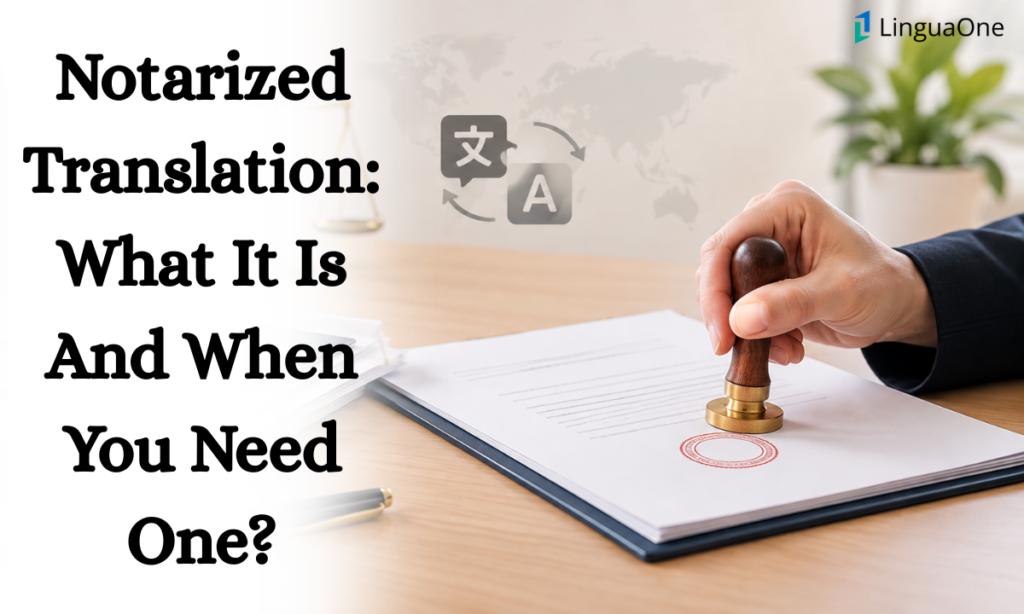
A notarized translation is a translation with a signed certification statement from the translator, where that signature has been witnessed by a notary public. The notary watches the translator sign, checks their identification, then adds their own seal and signature confirming the signing took place.
That is the whole of it. The notary is a witness to a signature, nothing more.
What The Notary Actually Confirms?
The notary confirms three narrow things. That the person signing is who they say they are, that they signed willingly, and that the signing happened on a particular date in front of the notary.
The accuracy of the translation itself comes from the translator’s certification statement, not from the notary. That statement is what makes a translation certified, and it is the part that actually vouches for the work.
What The Notary Does Not Check?
A notary does not read your translation. They do not compare it against the original document. In most cases they do not speak the source language at all, and they are not permitted to assess translation quality even if they do.
This matters because it tells you what notarization is for. It adds a layer of identity verification for institutions that want it on record. It adds nothing to the quality of the translation. A poor translation that has been notarized is still a poor translation, now with a stamp on it.
Certified And Notarized Translation Are Not The Same
This is where most people get stuck, so it is worth laying out plainly. We went deeper into the certification side in our guide to what a certified translation is, but the comparison below covers what you need for a decision.
| Certified Translation | Notarized Translation | |
| What it confirms | The translation is accurate and complete | The translator’s identity and signature |
| Who signs | The translator or agency | The translator, witnessed by a notary |
| Who checks quality | The translator, professionally | Nobody at the notary stage |
| What you receive | Translation plus Certificate of Accuracy | The same, plus a notary seal and signature |
| Typically required by | USCIS, universities, courts, employers | Some state offices, foreign consulates, certain schools |
| Extra cost | Usually included | An added fee per document |
When Certified Is Enough?
For the large majority of document translation in the United States, certified is the standard and notarization adds nothing. That covers immigration filings, university admissions, most court submissions, and employment verification. Our immigration translation services are certified as standard because that is what the receiving agencies actually ask for.
When You Need Notarization On Top?
Notarization gets requested when the receiving institution has its own internal policy requiring it, which is more common with state level offices, some foreign consulates and embassies, and a minority of academic institutions.
The rule we give clients is simple. Do not guess, and do not assume more is safer. Ask the office receiving your document to tell you in writing whether they need certified or notarized. That single question saves more money than anything else in this process.
When You Need A Notarized Translation?
Certain documents attract notarization requests more than others, usually because they are used to establish identity or legal status.
Birth Certificates
The most requested document we handle, and the one where requirements vary most by receiving office. USCIS asks for certified, not notarized. Some state vital records offices and foreign consulates ask for notarized. Our birth certificate translation covers both, and we have written a fuller walkthrough of how to translate a birth certificate if you are starting from scratch.
Marriage Certificates
These come up in spousal visa petitions, name changes, and consular filings abroad. Consular filings are where notarization is most often genuinely required, because the receiving country sets its own rules rather than following United States practice. Our marriage certificate translation handles divorce decrees and annulment records on the same terms.
Academic Documents
Transcripts, diplomas, and degree certificates occasionally attract a notarization request from admissions offices, though credential evaluators generally do not require it. If you are going through a credential evaluation, our WES translation follows their rules, and transcript translation services covers university admissions.
Court And Legal Documents
Affidavits, powers of attorney, and sworn statements are the category where notarization is most likely to be a real requirement rather than an assumption, because the underlying document is often notarized in its original form too.
Does USCIS Require A Notarized Translation?
No. USCIS requires a certified translation. Federal regulations ask for a complete English translation accompanied by the translator’s certification of competence and accuracy. Notarization is not part of that requirement and never has been.
You can submit a notarized translation to USCIS and it will be accepted, because it contains the certification they need. You will simply have paid for something they did not ask for.
Where the confusion comes from is that other parts of an immigration case do involve notarized documents, such as an affidavit of support. The translation of a document and the notarization of a form are separate things. Our certified translations meet the federal standard on every order.
How To Get A Notarized Translation Online?

You no longer need to sit in an office for this. The whole process runs remotely in most states.
- Confirm with the receiving office whether you need certified or notarized
- Take a clear scan or photo of the complete original document, including both sides
- Send it to your translation provider and specify that notarization is required
- The translator completes the translation and signs the certification statement
- A notary witnesses that signature and applies their seal
- You receive the translation, the certification, and the notarial certificate together
Send the whole document rather than the section you think matters. Stamps, seals, reverse sides, and marginal notes all need translating, and a missing page is the most common reason a document goes back. You can upload your document and see the price before committing to anything.
What A Notarized Translation Costs?
Two separate charges sit in a notarized translation, and quotes that give you one number sometimes hide the second.
| Component | Typical basis | Notes |
| Translation | Per page or per word | Certificate of Accuracy usually included |
| Notarization | Flat fee per document | Set by state law in many states |
| Expedited handling | Surcharge | Optional, varies by provider |
| Physical copies | Per copy plus postage | Only if the office needs originals |
LinguaOne translates documents at $44.99 per page with certification included, in more than 100 languages. Notarization is available as an addition where your receiving office requires it. You can get a quote with the total shown before you order.
Finding Notarized Translation Near You
People search for a notarized translation nearby on the assumption that they need to hand over paper in person. For the translation itself, you almost never do. A clear scan is enough, and the finished documents arrive digitally.
Local becomes relevant when the receiving office insists on wet ink originals, or when you want to speak to someone face to face about a complicated file. We are based in Mankato and work across Minnesota, with document services running nationwide.
Mistakes That Get Notarized Translations Rejected
The problems we see most, all of them avoidable.
- Paying for notarization when the office only asked for certified
- Translating part of a document and leaving out stamps or the reverse side
- Assuming the notary checked the translation for errors
- Using a notarized translation that was produced years ago for a different application
- Names transliterated differently from the passport
- Submitting a photo so dark the seal is unreadable
- Translating the document yourself and asking a notary to witness it
That last one catches people regularly. A notary witnessing your own signature does not make a self translation acceptable, because the problem was never the signature. Most institutions require an independent translator, which is covered across our document services.
Frequently Asked Questions
Short answers to what people ask before ordering.
What Is A Notarized Translation?
A translation with a certification statement from the translator whose signature has been witnessed and sealed by a notary public. The notary verifies identity, not accuracy. The accuracy comes from the translator, which is why this sits under professional translation rather than anything the notary does.
Does USCIS Require Notarized Translation?
No. USCIS requires certified translation only. Notarization is accepted but unnecessary, and it adds cost without adding anything USCIS asks for. We walk through the full filing set in our guide to translating immigration documents.
Can A Notary Certify A Translation?
No. A notary cannot attest to the accuracy of a translation and is not permitted to, even if they speak both languages. They witness a signature. Certification and notarization are separate steps performed by different people.
Can I Translate A Document Myself And Get It Notarized?
You can have your signature notarized, but the translation will usually still be rejected. Institutions require an independent translator because a self translation carries an obvious conflict of interest. We answered this in detail for one document type in can I translate my own birth certificate.
What Does A Notarized Translation Look Like?
You receive three parts. The translated document formatted to match the original, a signed Certificate of Accuracy from the translator, and a notarial certificate carrying the notary’s seal, signature, commission number, and expiry date.
Does A Notarized Translation Expire?
The notarization itself does not expire, though the notary’s commission has an end date printed on the seal. What varies is the receiving institution, since some ask for a translation prepared within the last three to six months regardless of notarization.
What Invalidates A Notarized Document?
A missing or illegible seal, an expired notary commission on the date of signing, a signature added before the notary witnessed it, or an incomplete notarial certificate. Any of these can send the document back.
Is A Notarized Translation Legally Binding?
Notarization does not make a translation legally binding in itself. It records that a signature was properly witnessed. Whether the document carries legal weight depends on the underlying document, which matters most with contracts and business records.
Can You Get A Translation Notarized Online?
In most states, yes. Remote online notarization is now widely permitted, so the translator and notary meet over video and the seal is applied electronically. A small number of receiving offices still insist on a physical seal. If you are unsure which applies to you, contact us and we will check before you order.
How Much Does It Cost To Get A Document Notarized?
The notary fee is separate from the translation and is capped by state law in many states, usually a small flat amount per signature. The translation is the larger cost. Pricing questions are covered across our FAQ.
Which Languages Do You Notarize Translations In?
More than 100, covering personal, legal, academic, and immigration documents. Spanish translation is our most requested, and every language we handle is listed across the site.
Do You Handle Notarized Translations Outside Minnesota?
Yes. Document work runs nationwide and arrives digitally, so your location does not limit you. In person services including ASL interpreting are scheduled around Minnesota.
Getting It Right The First Time
Almost every problem in this process traces back to one missing step, which is asking the receiving office what they actually require. Certified or notarized, digital or physical, recent or any date. Four short questions, and the answers decide everything else.
Once you know, the rest is straightforward. Send a complete, legible copy of the whole document. Use an independent professional. Check your name against your passport before it goes anywhere.
If you are not sure which you need, tell us who is receiving the document and we will tell you what they usually ask for. You can read more about us if you want to know who handles your files, or browse the blog for guides to the documents that come up most.

